Things that go bump in the dark.

For our final piece the CCTV group decided to create a piece of installation art using the fascinating piece of equipment at our disposal. Marita Sturken states that “An installation both defines and contains space, situating, if not controlling the viewer within it.” (( Erika Suderburg (2000) Space, Site, Intervention: situating installation art. Minneapolis: University of Minnesota Press. P. 287 ))  The idea for our piece was that while in the CCTV room the audience would be able to experience every other room in the house, placing them in a position where they could understand the format and use of the space in a way that they had not experienced it in the rest of the performance. Seeing as all of the rooms were occupied during the performance we decided to see what it would be like for the rooms to be captured with very few signs of life, and once we realised the potential that this emptiness created we decided to stick with it.

Full screen night filming by Lizzy Hayes, Lauren Hughes, Faye Mcdool
Seeing the rooms from a different perspective reminded me of Bollnows Human Spaces (2011) and how different each of our safe house rooms were from the definitions and purposes he proposed. Bollnow states that the furnishings and furniture play a part in the aura of a room and that “bare, empty rooms have a chilling effect” ((Bollnow, O.F (2011) “Human Space” London: Hyphen Press, p. 144)) and that “disorder and neglect have a quieting effect” ((Bollnow, O.F (2011) “Human Space” London: Hyphen Press, p. 144)) and due to the empty and neglected state the house was in it was easy to agree with him.
The emptiness and neglected state of the house became emphasised in the dark state that we filmed in.
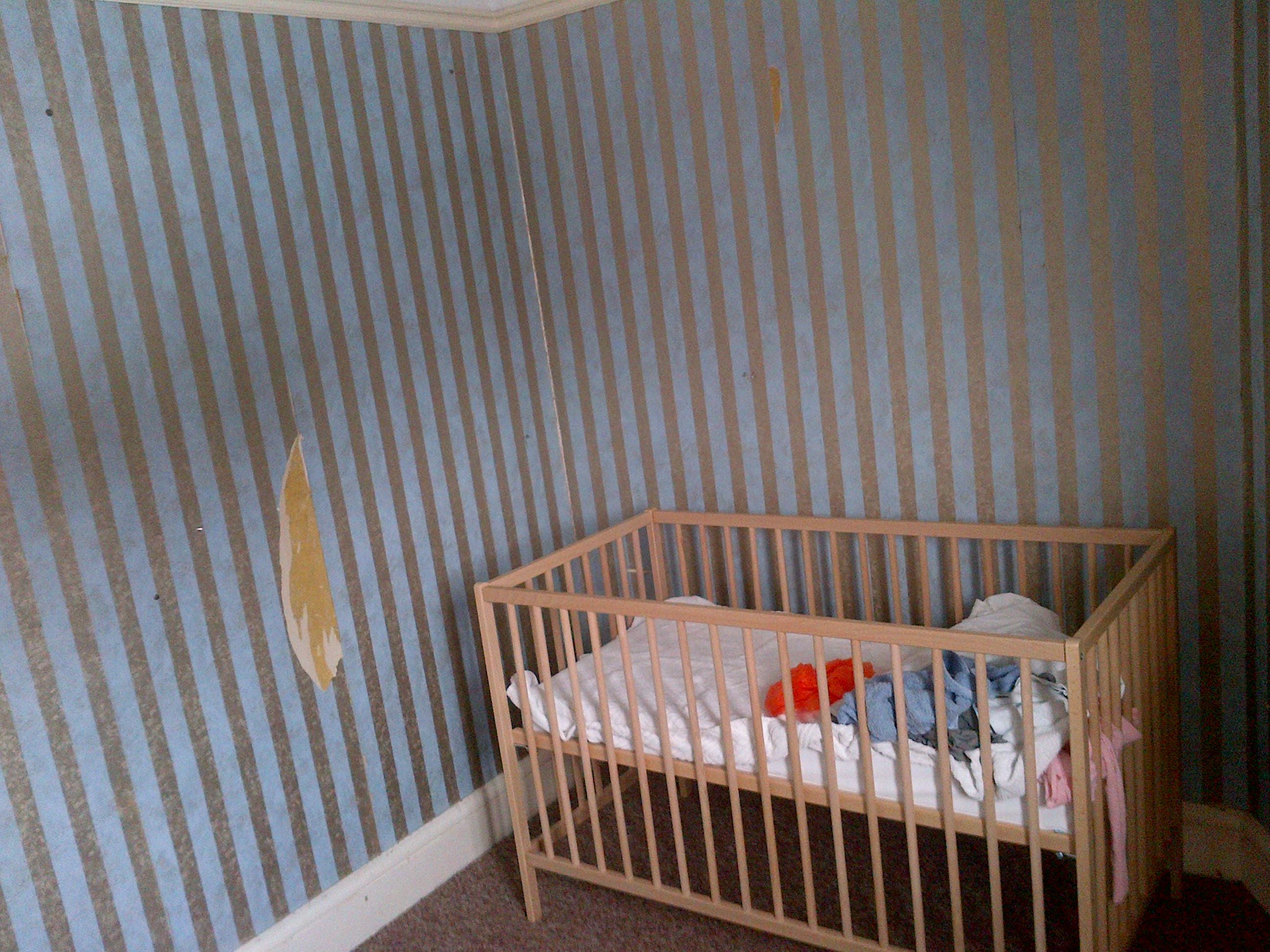
IMG-20130122-00470

Image by Jozey Wade 2013

The cot room (above) had a chilling, spooky quality to it that does not represent home, even in the day light. As many of the ‘residents’ have mentioned, we doubt that the room would feel that bad if it wasn’t for the presence of the cot itself. But I think it was key for us to remember when filming was that the room was made to feel so unsettling on purpose. The true nurturing purpose of a child’s nursery is lost in a sort of dark translation in the house due its requirements for training and we were able to use that to our advantage when filming, making the images we captured as uncomfortable as the actor being filmed felt.

Installation piece- Cot Room By Lizzy Hayes, Lauren Hughs, Faye Mcdool

Other spaces that in the day time might not be pleasant, but had never been scary, transformed beyond what I imagined they would. The kitchen became colder and harsher and the introduction of a spot light to the living room gave the opposite effect to the warmth that we expected.
Instead of just filming the bare rooms we had one of us walk through or occupy the space in a minimalistic manner. Bollnow suggested that  “the dwelling becomes an impression of the individual who dwells in it” ((Bollnow, O.F (2011) “Human Space” London: Hyphen Press, p. 145)) and I think that in capturing snippets of life in each room we were in effect stating that the people who were seen are not permanent residents, but are instead shadows passing through. These hints of movement acted as suggestions of life in an otherwise still setting. Without realising it I think we created something very much like Gary Hills installation piece, The Viewer, which I talked about in a previous post, in that the person seen in each image was not there to be interacted with or to portray a character, but were there to prove their existence.
The final result of this nights filming was nine separate one minute clips of footage, each representing one room and containing a different movement at a different time.

Installing…
Please wait…

“Installation art actively engaged with the experience of the human perception, which tested its limits and expanded its possibilities” ((Oliveira, Nicolas de, Nicola Oxley and Micheal Petry (2003) Installation Art in the New Millennium, London:Thames & Hudson, Ltd., p. 6.)).

Mixing Installation Art and a live performance. Can they be argued to be intertwined?

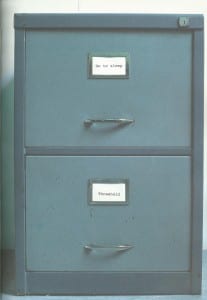
Borofoky, Jonathan (2000), ‘Dream Drawings (1971-87)’ in Susan Hiller Dream Machines, London: Hayward Gallery Publishing, p. not paginated. Shankie, John (2000), ‘Go To Sleep (1995)’ in Susan Hiller Dream Machines, London: Hayward Gallery Publishing, p. N.P.


Robert Storr states that “the experience they provide is much like wandering onstage and picking up loose pages from a script, overhearing bits of recorded dialogue and trying to figure out what the setting is…and what actions might still be taken” ((Oliveira, Nicolas de, Nicola Oxley and Micheal Petry (2003) Installation Art in the New Millennium,  London:Thames & Hudson, Ltd., pp. 17-18.)). If we create an installation performance, rather than a simple piece of tangible art, we are hoping it will have the same effect; two separate, yet intricately combined performances happening simultaneously, yet only one audience member is directly engaged with one of two performances, creating a sense of anticipation, wondering what will happen next, and with who the performance will engage with.

If our bodies become a piece of installation art work, this would change the dynamic of the performance – rather than simply having the audience members as passive onlookers, we turn them into active voyeurs who have the option to give a ‘physical’ addition to the performance. To frame this within the work of an existing performance artist, Marina Abramović has created this audience-performer interaction, but rather than choosing to limit the audiences’ involvement, and therefore their effect on her, she gave them free reign, something which we are keen to limit. Abramović stated after her performance of Rhythm 0 (1974) she realised that “…the public can kill you. If you give them total freedom, they will become frenzied enough to kill you” ((Abramović in Sean O’Hagan (2010) ‘Interview: Marina Abramovic’, The Guardian/The Observer, Online: http://www.guardian.co.uk/artanddesign/2010/oct/03/interview-marina-abramovic-performance-artist (accessed 01st March 2013).)).

“Rather than only “touching with the eyes” [we] arrive at seeing through a sense of touch” ((Hiller, Susan (2006) Susan Hiller: Recall. Selected Works 1969-2004, ed. James Lingwood, Gateshead: Baltic, p. 17)) implies that physical contact is essential is really ‘seeing’ the performance, rather than simply observing. To leave your mark on the performance as an audience member whilst also taking something personal away for the experience. Allowing the audience to touch you as a performer is a very intimate act, especially with all the connotations of the bedroom, but for the performance to be ‘seen’ rather than simply viewed, I think that is it essential  that the audience must leave their trace in the space, while also taking some of the performance away with them.

“The immersive space remains fundamentally an experimental and sentient place, though it is also a means of escaping our everyday conditions” ((Oliveira, Nicolas de, Nicola Oxley and Micheal Petry (2003) Installation Art in the New Millennium, London: Thames & Hudson, Ltd., p. 53.)).

While exposing the audience to something which is usually  witnessed behind closed doors, we are  creating a fully immersive space; a space which holds its own realities, rules and atmosphere. By surrounding the audience in a fully fledged experience, this will allow them to temporarily escape from their everyday conditions, but hopefully allow them to leave our created world in a changed state, with an experience which they will hopefully remember. Be it either through some traumatic experience, or one of pure safety and comfort.

When you were younger your cupboard was home to a monster or two. Under your bed held the Boogie Man. And your bed protected you, kept you safe. Your night light or landing light also made you feel safe.

Yes?

What happens if we expose those ‘monsters’ hiding in cupboard and the inherent fears that something is lurking under the bed and bring them to light in such a way that you are unable to escape them? Susan Hiller argues that “I think we have enough mysterious darkness within ourselves and our own culture to be getting on with” ((Hiller, Susan (2000) Dream Machines, London: Hayward Gallery Publishing, p. N.P.)), implying that we don’t need to show the darkness which dwells within; to leave the grotesque at home and not to solidify it in art. However, I think this give us more justification to stage the grotesque and hidden secrets. For people to face their “mysterious darkness”, we must show the subconscious and the usually hidden fantasies unashamedly in order to evoke a reaction from the audience. Whether it be fear, disgust, admiration or even arousal.  

The Kitchen Show

“Perhaps what is most interesting in Baker’s work, an ingredient of the adjective ‘incomparable’, is that her work cuts across any strong distinction between the visual and the performing arts.” ((Barrett, Michele and Bobby Baker (2007), Bobby Baker: Redeeming Features of Daily Life, USA: Routledge, p.3)).

Bobby Baker’s, The Kitchen Show was something I found particularly interesting to watch. Her performance was of her in a kitchen with a commentary over the top explaining what she is doing, why she is doing it, and how it makes her feel – in the style of a cooking programme. The only difference was it wasn’t about cooking in her kitchen; she was using the kitchen and items in it to create something unusual and absurd. It starts with her stirring a pan of soup with a wooden spoon. In order for her to hold the wooden spoon she decides to tape her hand in that shape so she can grip it easier. As she does this she describes it so naturally, as if it is a completely normal thing to do in a kitchen. This I found quite humorous, and as the show goes on the ‘tasks’ she does become even more outrageous. Below shows a clip of some of her activities:

dailylifeltd (2012) Kitchen Show by Bobby Baker, Online: http://www.youtube.com/watch?v=RIbzhmljz_k (assessed 3 March 2012).

Previously I have discussed ideas to change the kitchen completely, having objects in the space that aren’t meant to be in there. After watching The Kitchen Show, I very much like the idea of actually using the kitchen for what it is, with the absurdity of the rabbit being enough. I will experiment with what Bobby Baker did, using kitchen utensils in different ways, for example she tied a wooden spoon in her hair and wore a cheese grater on a piece of string around her neck, and talked about it like its normal. Someone dressed as a rabbit doing everyday tasks like making the audience cups of tea or getting them a snack to eat isn’t normal to watch, similarly to Bobby Baker’s work. It would also be quite a struggle to do everyday tasks with mitten-like hands, big rubbery feet and a giant head with limited space to see out of, and would therefore be very interesting to watch the struggle I would have to endure just to do a simple task.

Research and Performance ideas

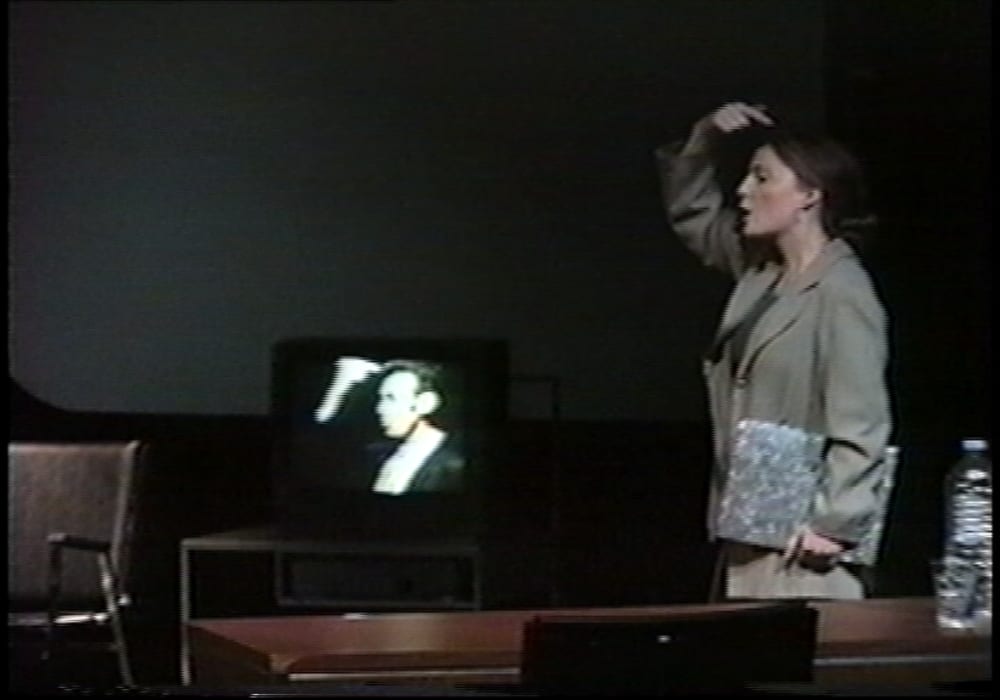
After reading about Fiona Templeton and Michael Ramtomski’s performance Recognition it triggered some thoughts for me about how we could use the multimedia in our performance. We have discussed using pre recordings and projections but how close can we cut that line between the solid performance happening for the audience and the multimedia? I was touched how Ramtomski lived on through this performance after his death through the power of multimedia in performance.

Recognition 7

Image: Online: http://presence.stanford.edu:3455/Collaboratory/352 (accessed: 3rd March 2013).

The piece involves Templeton interacting with a video of her late collaborator Ramtomski and a woman you cannot see which is presumably her. “She speaks words that are repeated moments later by the man in the video, or by her own voice recorded on the video; she turns the sound down and speaks words aloud as the man mouths them; she speaks in time with her own voice on the video and she speaks in his voice.” ((Baker, Clive (2000) New Theatre Quarterly 63, Cambridge: University Press p.208)). In the book New Theatre Quarterly 63 they describe the performance and how Templeton made the absent present through multimedia not only by playing a video of Michael Ramtomski but interacting with the media to make that presence much more real. A similar piece I saw was a third year student’s solo performance which I assume was inspired by Templeton’s work, where he used 3 different videos of himself and interacted with each one individually, each represented him in the past, one within hours, one within days and one slightly more. As he had this very convincing conversation with them he proceeded to inform them of the performance they will be taking part in (the one he was currently in). This type of performance evidently takes a vast amount of time and dedication however it could be used within our piece as due to health and safety reasons not all performers can be present for each performance.


Purging.

Performance artist Andre Stitt here talks about how he uses certain substances in is performances as representation for feelings/ emotions etc. Some of the substances he uses are chosen based on personal memories of his, like the use of tar and feathers. At the end, as the narrator points out, he pushes the boat he has covered in certain substances out into the sea and it can be seen as a release or “letting go” of the dark memories he and/ or the audience possess. Straight away this struck me, in relation to what I have been working on in the bathroom.

In his book, At Home: A short history of private life, Bill Bryson talks extensively about plague and disease in history and how a great deal of it has related to being unclean and not washing. In his chapter about the bathroom, he discusses how people in the Middle Ages thought that to “plug the pores with dirt” ((Bryson, Bill (2010) At Home: A short history of private life, London: Black Swan))  was the best way to protect themselves from plague. “Most people didn’t wash, or even get wet, if they could help it – and in consequence… Infections became part of every day life… serious illness accepted with resignation” ((Bryson, Bill (2010) At Home: A short history of private life, London: Black Swan)). Nowadays, obviously, we are aware of the fact that quite the opposite of this is true. We wash daily, to clean – or purge – ourselves of dirt and grime gathered through the day, and to prevent ourselves from smelling and getting ill.

This idea of purging made me think of Andre Stitt’s work as a kind of purge also – like in his performance Where the Grass is Greener as seen in the video above. How the ritualistic aspects of his performances – with the feathers and pushing the boat out into the sea – help him let go or purge himself of unpleasant memories or feelings. How could I apply this to the bathroom?

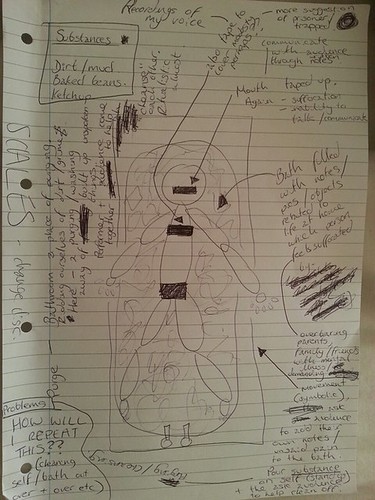
forsite

After spending some time in there and sketching out some thoughts (as can be seen above), I tried to apply my previous ideas of how home life, or people within your home life can make you feel suffocated there. And how, more often than not, it is impossible for us to talk about these issues because we are just supposed to put up with them, or we think we are, if the people involved are family or people we love. Examples of this include overbearing/ strict parents (not necessarily physically abusive but perhaps), children with behavioural problems, loved ones with long term illnesses or even mental illnesses (like depression etc). I played with this idea of things we can’t say that grate on the inside of us, and how some sort of action or ritual within the bathroom could help us release this, or purge ourselves of it. (after all, as we have discussed, the bathroom is a place of purging anyway).